How it works
How AntiClone finds and proves copies of your shop
Every match rests on something that can be verified: the same shop ID, the same photos, your contact details. For each point you see where it comes from. At launch, AntiClone runs as a Shopify app right in your admin.
AntiClone compares much more than your name
Whoever copies a shop changes the name first. So AntiClone compares what is not so easy to change, and it only counts a site as a match when there is a strong technical link or several matching points come together.
Product photos
From the Pro plan: even when uploaded again, renamed, resized, mirrored or watermarked.
Descriptions
Even when only parts were taken or rearranged.
Product names
Which of your products the site lists under which name.
Home page
The title and text of your storefront, even with the name swapped out.
Shop ID
Shopify ID and shop files, even when the copy runs on someone else's server.
References
Images loaded directly from your shop, and links back to you.
Legal notice (Impressum)
Email, phone and VAT ID. In the radar index only as an irreversible fingerprint, in the evidence for your cases in plain text.
Similar domains
Hundreds of spelling variants of your name: typos, swapped letters, other endings.
A single identical product does not make a copy: AntiClone recognizes goods sold by many independent shops and manufacturer texts as widespread and sets them aside. You enter your own domains and those of your resellers as allowed, and they never count as a copy.
Clone Radar
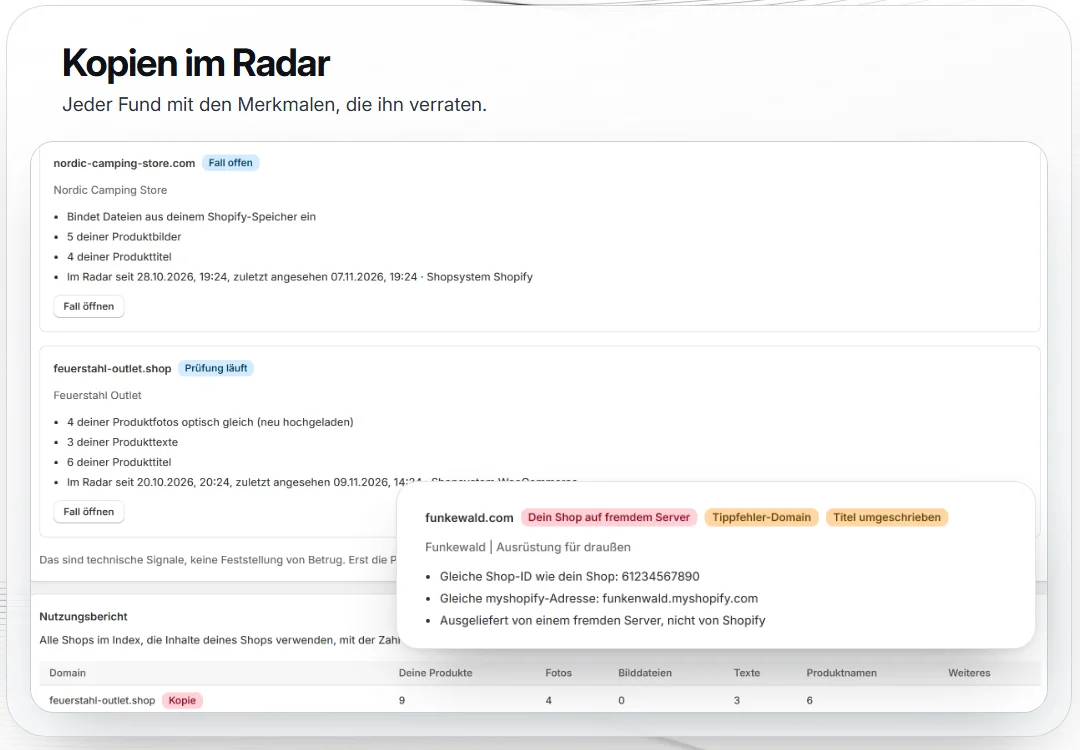
The radar looks at new websites shortly after they go live
The radar looks at new websites shortly after they go live and compares the shops among them with yours, around the clock. That is how it finds copies whose address you would never guess.
- finds copies even under a completely unrelated name
- recognizes shops on Shopify, WooCommerce, Shopware, Magento and other platforms
- looks at half-finished shops again after a few hours and days
Two views
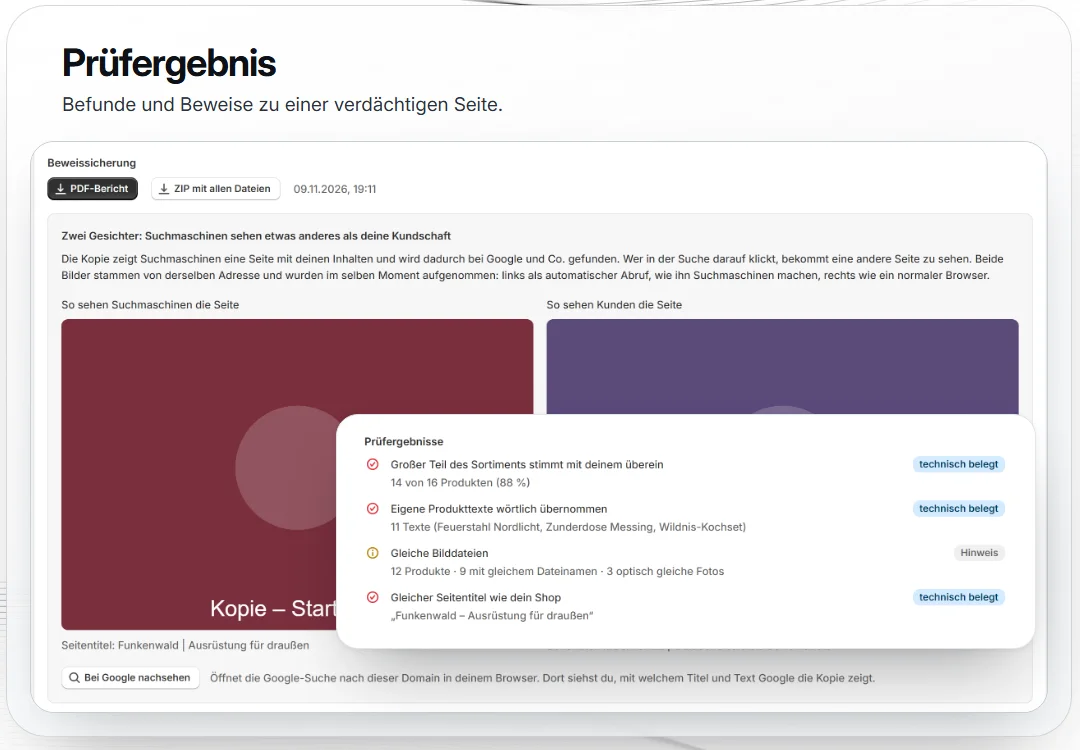
AntiClone records what Google sees and what your customers see
Mirrored copies show search engines and ad reviews your original, and show people in a browser something else. So AntiClone records both views of a suspicious site. If they differ, the report states this as a finding, and both views are secured as evidence.
- both views captured at the same moment, side by side in the report
- Google calls this disguise cloaking, and it violates the spam policies of Google Search
- the comparison with your shop runs on both views
Early warning
Your shop speaks up when it is running somewhere else
A small, invisible script in your Shopify theme knows the real address of your shop. If your shop code suddenly runs on someone else's domain, for example because someone mirrors your shop one to one, it raises the alarm instantly. You switch it on once in the theme editor.
- on your own shop it sends nothing and sets no cookies, so it does not need a cookie banner
- included from the Basis plan
- every alert triggers a check of its own, and only that check shows whether your shop really runs there, so forged alerts do not produce a match
expected   [your-shop].com
running on [your-sh0p].net
path       /collections/bestseller
referrer   google.com
Alert recorded, check started
Shop comparison
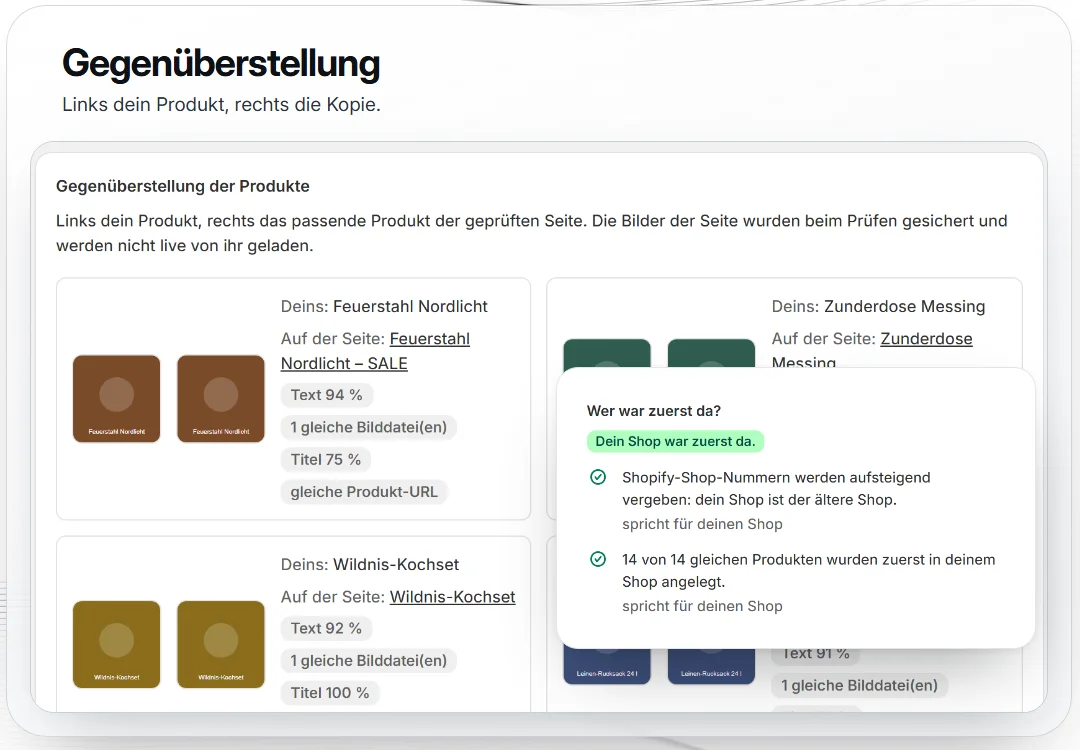
Products, texts and photos are compared, even edited ones
AntiClone compares the suspicious site with your catalog. It recognizes identical products and texts taken word for word, and from the Pro plan also your photos, even when they were cropped, brightened or renamed. On top of that come the legal notice and Shopify IDs, and the proof that your shop was there first.
- every point is explained, and your product is shown next to the one on the copy
- a priority score shows how urgently you should take a look, but it is not a verdict on the site
Similar domains
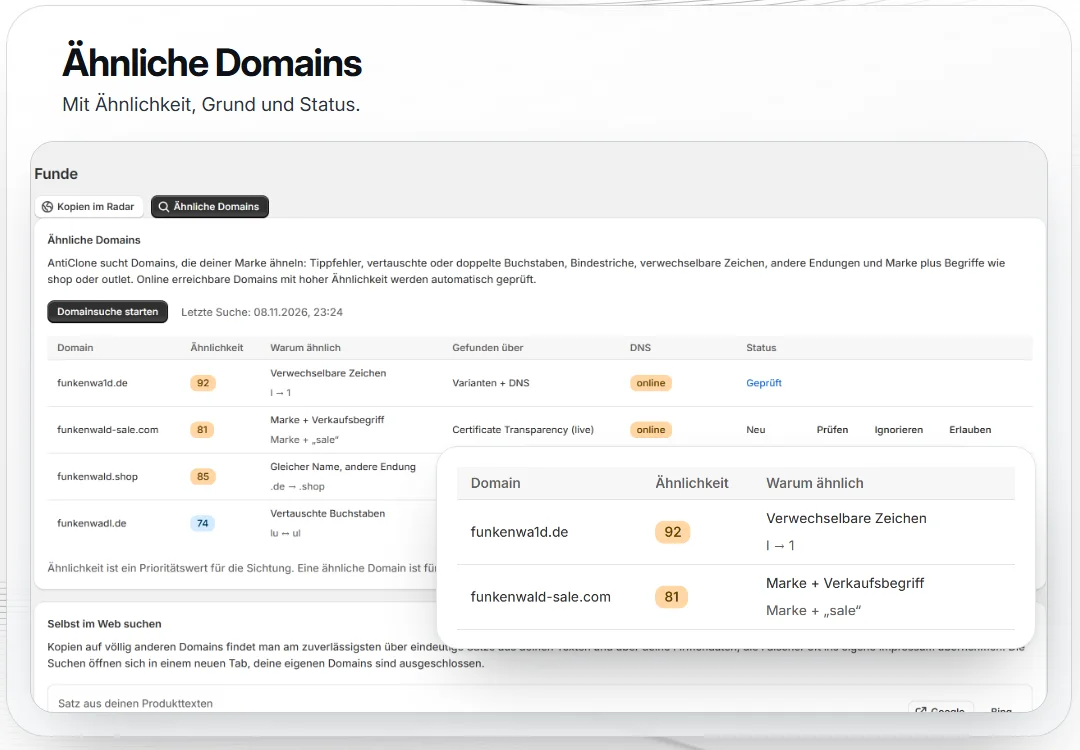
Addresses that look confusingly like yours are noticed every day
AntiClone builds hundreds of spelling variants of your name: typos, swapped or doubled letters, lookalike characters such as 1 instead of l, other endings, and your name with additions such as shop or outlet. From the Basis plan it checks every day which of them are registered and reachable, and reachable sites with high similarity are checked automatically.
Evidence package
An evidence package that anyone can verify
For every case, AntiClone creates a package that hosting providers, platforms and lawyers can work with: real browser screenshots of the original and the copy, the page source, the server responses, and the registrar and hosting provider, all with a timestamp and checksum. You download the PDF report and the ZIP once AntiClone has reviewed your confirmed case.
Screenshots         PNG
Page source         HTML
Server responses    JSON
Registrar, hosting  RDAP
Check report        PDF
Checksums           SHA-256
AntiClone provides the evidence and you make the judgment
AntiClone never calls a site “fraud”. It shows what matches, secures it and leaves the decision to you.
Fixed rules instead of a black box
For each point you see why it counts. The comparison works without AI, with openly explained rules, and a priority score is an order for your attention, not a probability of fraud.
Nothing without your confirmation
No report leaves AntiClone without your click, and AntiClone checks every confirmed case before sending. If AntiClone rejects a case, you are told right away, with the reason.
Only fingerprints of other shops
In the radar index, AntiClone stores contact details and product titles of other shops only as an irreversible fingerprint. Every merchant sees only matches for their own shop.
No email without a reason
Only things you need to act on are emailed right away. A weekly report collects everything else, and it only comes if something happened that week.